

By Tamryn Spruill
An electric 2026 WNBA Finals between the Golden State Valkyries and Atlanta Dream served as a blueprint for franchise excellence. The finals ended with the Valkyries defeating the Dream. The WNBA’s two best defensive teams hounded each other all series–the way controversies had dogged the league all season.
The WNBA has surged in popularity in recent years. Arena attendance and TV ratings have climbed; team valuations are trending upward. But the all-female league that is about 70 percent Black and roughly 30 percent queer has become fodder in the country’s latest culture wars. How the country views and values those demographics is at the heart of the league’s longtime struggle to gain mainstream acceptance. Now that it defied the odds and attained unprecedented visibility, the WNBA is facing an onslaught of unfair criticism steeped in misperception and manufactured grievance.
Near the start of the season, a group of 11 Republican lawmakers–instead of tending to the priorities of their constituents–sent a letter to WNBA commissioner Cathy Engelbert demanding that the league take accountability for “repeated acts of unnecessary physical hostility and violence” against Indiana Fever star Caitlin Clark. The letter suggested the hard fouls on Clark, who is white, may have been “racially motivated.” The group additionally called on the Department of Justice to investigate–as if those employees need busywork.
Not long after the Republican lawmakers’ charade, Clark’s teammate, Sophie Cunningham, garnered headlines after calling for trans women to be banned from women’s sports. Cunningham achieved her personal aim of aligning with right-wing causes in the interest of her post-playing career. Again, though, the league was in the headlines for reasons other than basketball.
Then, in the weeks leading to the WNBA Finals, the league found itself mired in another controversy – one that, despite the league’s many gains in recent years, boiled down to the insidious lack of basic respect for women’s sports. The Dream had reached the pinnacle of their sport, but found themselves yet again playing second fiddle to the men’s game. State Farm Arena was booked for Atlanta Hawks games and concerts. According to the team’s owners, WNBA leadership failed to treat their concerns with any seriousness. Seeking the biggest crowd possible for their Dream, the owners collaborated with the Hawks and State Farm Arena on solutions. Game 3 of the WNBA Finals was played a day earlier than originally scheduled, Game 4 was moved from a 3:30 p.m. ET start team to 1 p.m., and Game 6 was a 12:30 p.m. matinee on a weekday.
Not exactly primetime.
But at the end of the season, despite all of the drama, an undeniable feeling of triumph prevailed. The WNBA Finals were a thrilling affair that for the first time in league history stretched to seven games. And when the confetti fell, and the Valkyries finished their celebratory drinks, it seemed clear that the series had pointed a way forward for the league that has struggled to find a path. The answer is in the opposite direction of the league’s past travels: It requires embracing its identity rather than dancing around it.
For decades, the WNBA and NBA stifled the league’s growth by shielding and suppressing Blackness and queer expression while amplifying a single white player in any given season. Before Clark, there were other wholesome-looking, heteronormative stars: from Sue Bird, the No. 1 pick in 2002, to Sabrina Ionescu, the No. 1 pick in 2020: when the league centered Ionescu in every gamebreak promotional spot on WNBA League Pass, either alone or spotlighted in group photos. Never mind the stars who had won things in the years leading to Ionescu’s arrival: Sylvia Fowles, the 2017 champion, league MVP, and Finals MVP; Breanna Stewart, the 2018 champion, league MVP, and Finals MVP; and Elena Delle Donne, the 2019 champion, league MVP, and only professional women’s basketball player, among an elite list of NBA players, to record a 50-40-90 season.
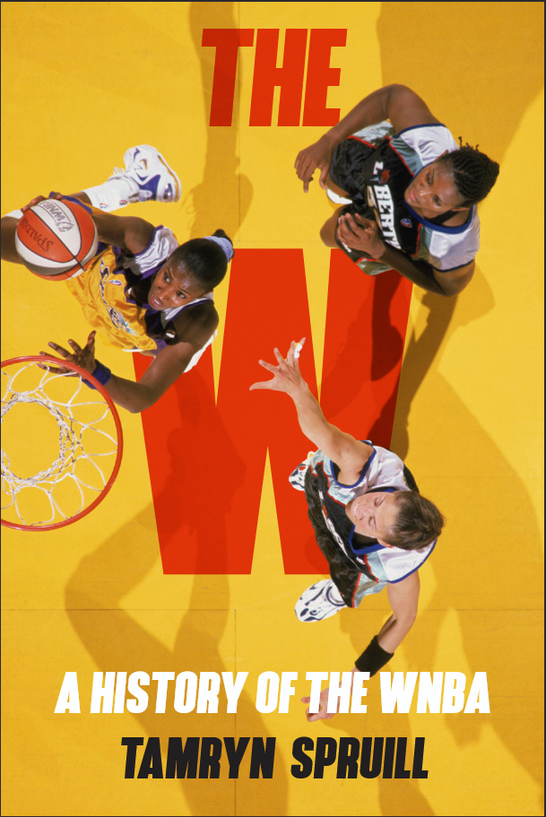
Fowles is Black; Stewart and Delle Donne are white, but in relationships with women. A’ja Wilson, meanwhile, was the unanimous 2018 Rookie of the Year and rising toward superstardom. She, not Ionescu, was viewed among WNBA purists and peers as the rightful face of the league, and the WNBA showed no signs of willingness to elevate Wilson, who is Black, to that status. Kelsey Plum, Wilson’s teammate at the time, was the only player white player to vocally protest the league’s habit of prioritizing white players. In 2022, women’s sports historian Cat Ariail, Ph.D, in an interview for my new book, The W: A History of the WNBA, identified a test to whether the WNBA “will or will not continue to get in its own way” as the degree to which the league and its corporate and media stakeholders celebrate “the ascendance of Wilson” instead of sustaining “the Sabrina Ionescu propaganda project” (p. 358). The league moved away from Ionescu, but made Clark the object of its attention.
The Valkyries and Dream — in their respective violet Pride and blue Black joy — embody what the WNBA has spent its existence shunning. Those teams got to the top by establishing winning cultures based on belonging, and trickling that ethos down to their fan bases. However, those who were most desperate to promote Clark as a savior of the WNBA predicted that the playoffs would be a dud after her team, the Indiana Fever, were bounced in the first round.
The Dream, meanwhile, sold out their three games in Atlanta, the Valkyries sold out their four games in San Francisco, and millions of viewers tuned into USA Sports’s refreshingly balanced coverage. Play-by-play calling by Kate Scott, analysis from Tamika Catchings and Sarah Kustok, and the sideline reporting of Meaghan McPeak drew their commentary from the narratives being written by the players on the court. Out was the agenda-pushing of ESPN, where the play-calling of Ryan Ruocco in recent seasons made games feel like one long advertisement for Clark and her latest Nike shoe.
Efforts to hoist Clark above the rest of the league was already tiresome. In 2026, Ruocco’s servility to amplifying the WNBA’s single white female du jour slid into a realm of blatant offense–to Clark’s teammates, to the other team’s players, to viewers, and most of all, to the integrity of the sport. Additionally, the relentless harping on Clark’s name in lieu of actual game-calling rendered the broadcast useless to the visually impaired. Anyone listening to USA Sports’s broadcast, though, would’ve had no questions about the goings-on of the game.
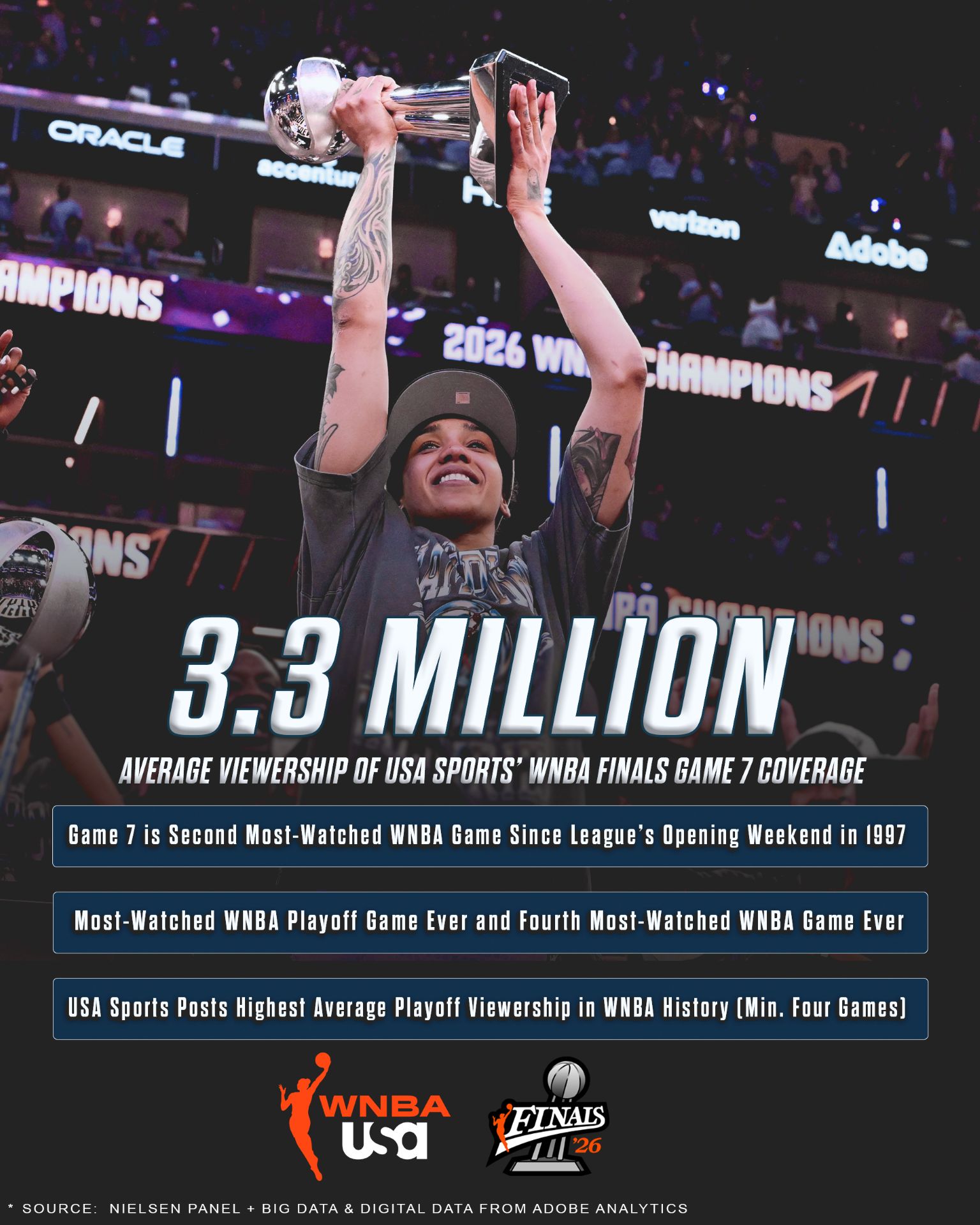
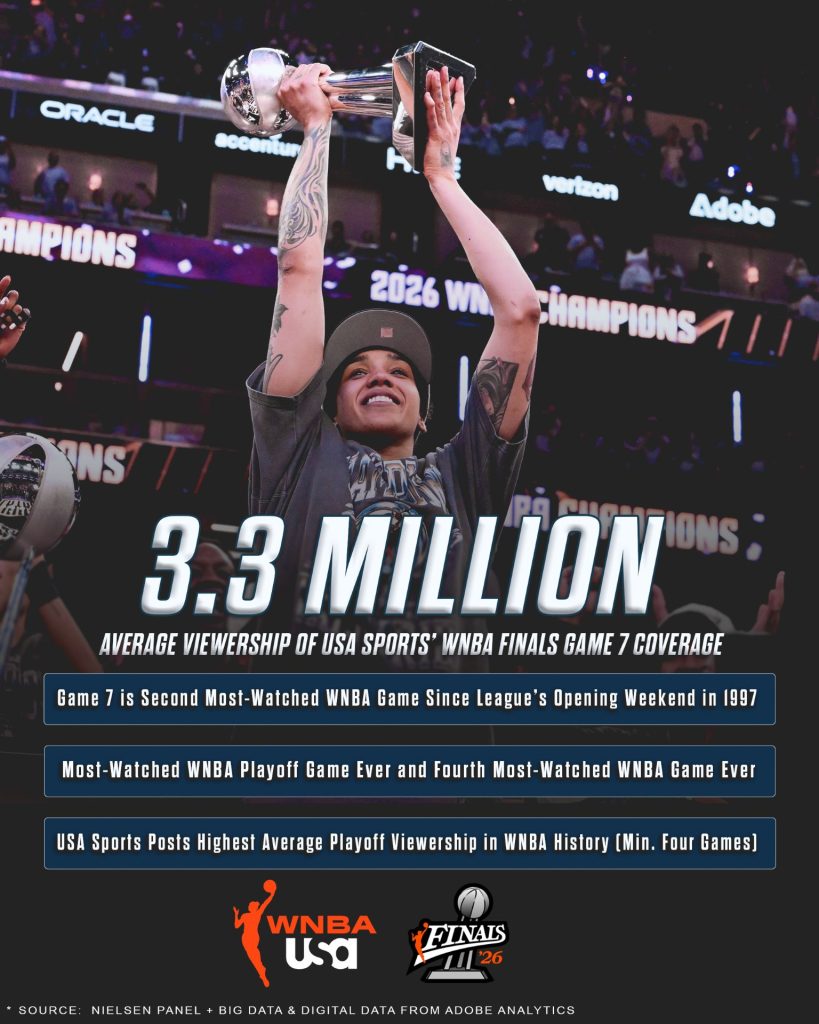
USA Sports’s principled broadcasting of the 2026 WNBA Finals charted new territory. With 3.3 million viewers tuning into Game 7, the network produced the most-watched WNBA playoff game of all time.
No Caitlin.
No ESPN
(Credit: WNBA via X.)
In the 2026 finals, the Valkyries and Dream, players and front offices, were supreme representatives of the WNBA as it actually is. The athletes’ tough and gutsy performances showed that good basketball, without the presence of a Great White Hope, sells. That elite talent sells–whether it comes from a brown-skinned Southerner wearing braces and goggles or her white rookie phenom from Down Under. A heavily tattooed Finals MVP who dedicated a big regular-season performance to “the gays” or her white teammate who speaks English with a strong Italian lilt.
These players and their franchises reflect the beautiful diversity of Earth’s humanity. And the Valkyries and Dream for two weeks in October showcased the best of what sports offers to society: camaraderie, togetherness, and reasons to cheer. Those franchises brought joy to their fan bases worldwide and contributed to the economies of the cities in which they play. For San Francisco, that meant selling out every regular-season home game.
It would be a mistake to attribute the wild success of the 2026 WNBA Finals to novelty. For the two expansion teams chasing a first title, and the series culminating in an historic Game 7, the interest was not a fluke, but a vote cast in viewership, dollars, and clicks. People showed up for what they wanted to see: “the thrill of victory and the agony of defeat,” as stated in the old ABC tagline. Competitive fierce basketball is what they wanted and it’s exactly what they got.
A big part of the season’s success was the WNBA’s choice to expand its roster of broadcast partners beyond the ESPN/ABC ecosystem. The arrival of new voices and approaches to game production have heightened the quality of broadcasts. Along with USA Network, games on CBS Sports, ION, NBC/Peacock, and Prime Video have established new quality standards for covering the league.
Higher ratings prove as much, and at NBC Sports during the regular season, Hall of Famers Sue Bird and Cheryl Miller, along with Maria Taylor, capably and confidently discussed the latest trumped up narrative to deface the league, this one involving DiJonai Carrington, while other networks avoided the subject.
Keeping the league’s former stars in the broadcasting mix was an important factor in the uptick in television viewership. Media partners would be remiss to relegate their presence to anniversary seasons. From Chamique Holdsclaw and Teresa Weatherspoon to Cynthia Cooper and Sheryl Swoopes, these women who at a time burned up the courts offer important linkages to the past. They are the living history. For a league that was long deprived of meaningful, respectful coverage, their perspectives are vital. They’ve more than earned the delayed visibility now bestowed upon them and any financial rewards coming to bear.
But it was the Valkyries-Dream finals that offered a blueprint for leaguewide success: one that embraces the diversity of the league’s players and names get mentioned according to merit not hope and hype. The players, as a collective, must demand nothing less moving forward.
Players benefiting most from systems that shortchange other players have a duty to be the loudest opponents of such systems. Visibility matters. It is a direct line to income streams, which everyone knows. Withholding the spotlight from women whose accomplishments say they deserve it can’t be shrugged off as an oversight. There is nothing innocent about upholding systems of discrimination and suppression. Staying silent to these norms facilitates their continuation; sustaining hierarchical structures based in white supremacy undermines society and the league.
(Credit: WNBA via X.)
Caitlin Clark didn’t ask to become an object of political exploitation, and likely never considered that achieving her basketball dreams would come with this significant downside. To her credit, Clark has condemned racism. She has not, however, acknowledged the ways the preferential treatment she receives benefits her. She has not, at least not publicly, leveraged her platform and likeability with front offices and NBA Commissioner Adam Silver to make things better for others.
The WNBA survived for 25 years because players prioritized “we” over “me.”
It now thrives at 30 because of the women who were playing for the league’s future–because of those who took a stand against the mores that for decades had kept the WNBA teetering on the brink of extinction, as recently as 2020.
Continued success will only happen if the players push outmoded social paradigms out of their league.
Going forward, nothing short of a full embrace of players’ identities and the merit-based promotion of players should be considered acceptable because that path is not viable. The WNBA sustained itself by defying social norms that said women didn’t deserve to be professional athletes. I hate to make comparisons to the NBA, but doing so is necessary to underscore the double standard that continues to hold the WNBA down. The NBA doesn’t promote a single white face out of habit, or the belief that only a Nikola Jokić and Larry Bird will be enticing to the masses but a LeBron James and Magic Johnson won’t
The belief that the women’s league needs a white face is rooted in racism and sexism, because often mediamakers prefer that the athlete be a sexism. This scourge isn’t unique to the WNBA: In soccer, for example, Alex Morgan was the viral face of U.S. soccer, not Abby Wambach.
The WNBA got to three decades because the players united over the single goal of keeping the league alive. Now, in this new frontier of mainstream success, the players must galvanize around the complete repudiation of hierarchies that are now dividing the league as they’ve successfully driven wedges through society since the Europeans first stepped foot in what is now known as the Americas.
Promoting the storylines that the players write for themselves and their teams on the court should guide the promotional and marketing decisions of the league, sponsors, and media partners. The unprecedented success of the 2026 season emphatically proves the public’s eagerness to embrace the WNBA in its Black and brown and queer and multilingual truth. All who cheered for the Valkyries and/or Dream in the 2026 WNBA Finals–in the stands, in bars, or in front of televisions–issued a referendum to the league and its media partners.
For the sake of the 2027 draft class and beyond, let’s hope they listen.
Additional reading:
- Does Sport Media Raise Her Name? Examining Intersectional Representation in Media Narratives
- Her Dream Deferred: On the Status of Black Women (AAPF)
- Not Just Trolls – The Experiences and Effects of Online Harm on Elite Women’s Sport Athletes
Like this screen?
 Show your appreciation with a tip in any amount.
Every cent will be put to good use and keep the screens coming.
Path to publication:
On October 28, the “Ideas” editor at The Boston Globe commissioned me to write about the controversies of the 2026 WNBA season. I implemented the tremendous suggestions given to me and looked forward to the essay’s publication on Wednesday November 4. That morning, the editor informed me that they’d have to “spike” the piece because the blue wave that washed over the nation the night before shifted their editorial plans. Naturally, I was disappointed to have my first byline in the Globe nixed. It was also the first kill of my career. That those disappointments happened because of the blue wave? No complaints.