

By Tamryn Spruill
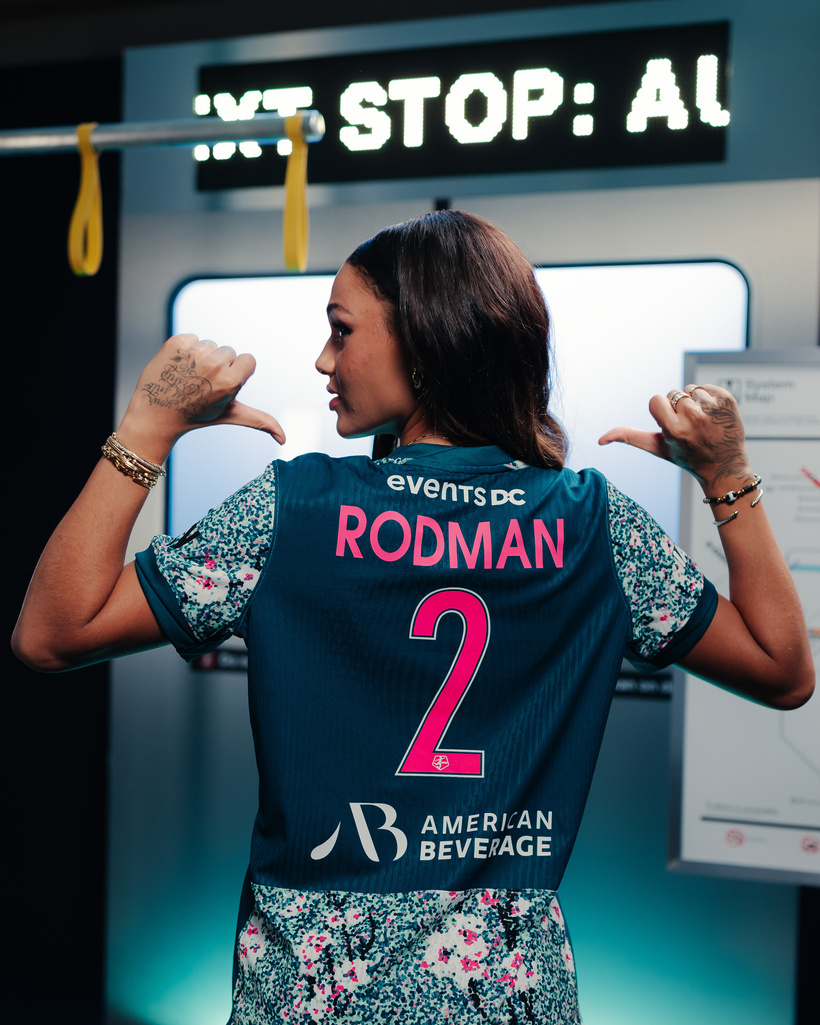 Trinity Rodman modeling her subway series uniform for the Washington Spirit. | Photo credit: NWSL and the Washington Spirit.
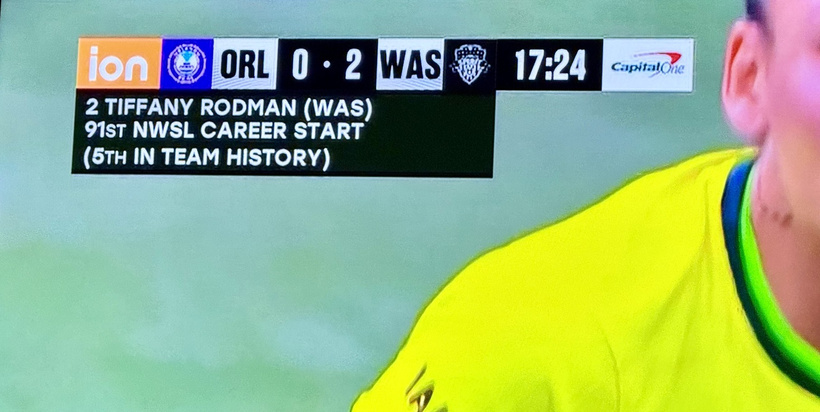
 ION Television referenced NWSL star Trinity Rodman as “Tiffany” during a recent broadcast. It wasn’t an innocent mistake or an oversight, but a micro-assault against the league’s biggest and highest-paid star.
Mistakes happen. Some have life or death implications; others are less serious. Getting a professional athlete’s name wrong on a nationally televised broadcast doesn’t impact the health and safety of anyone. A contingent of folks may view such an error as trivial, but not all blunders are innocent—especially during this time of the federal government’s feverish policy-shifting toward an anti-Black agenda that prioritizes removing Black women from positions of power.
There’s no one more powerful in the National Women’s Soccer League (NWSL) than Yongmee Michele Kang: the Yale-educated billionaire owner of the Washington Spirit, the Lyoness in France, and other franchises. Next in terms of stature is her million-dollar star: Trinity Rodman—the first player in NWSL history to sign a seven-figure contract. Not only is Rodman the highest paid player; she leads in jersey sales and is the league’s veritable face.
Who the fuck is Tiffany?
There isn’t a single player in the NWSL whose first name is Tiffany. So how did the ION Television production team—its graphics personnel in particular—come to slap that name onto the image of the iconic athlete? And how can anyone watching view the error as anything other than a malicious attempt to degrade a female athlete and Black woman?
The NWSL website includes media guides for every team. The Spirit’s has pages of player biographies, and each player’s name links to an audio file of that player saying her name and preferred pronouns. Other teams, such as the Boston Legacy, provide phonetic spellings.
The NWSL and its teams have done the work for the networks, announcers, graphic designers, and others covering the league. There is, thus, no excuse for getting a player’s name wrong, especially to the extent that someone—or some AI entity—renamed the league’s biggest star.
Yes, there is human culpability if an AI technology did the dirty deed; the quickness with which tech companies have forced fake human knowledge onto society is problematic, and the consequences of these technologies will only grow more severe. The algorithms bear the biases of the people who created them.
But maybe that’s the point: to disenfranchise and control, which is what mispronouncing the names of nonwhite people has always been about in the U.S.
Claiming that the error was unintentional does not erase the harm of misspelling or mispronouncing someone’s name—or in Rodman’s case, giving a person an altogether different name. A name is a key part of a person’s identity. Misnaming a person cannot be shrugged off as “not that big of a deal,” Myles Durkee, assistant professor of psychology at the University of Michigan, told the BBC in a 2024 interview.
“What makes it detrimental is the chronic pattern of doing this consistent mispronunciation,” Durkee said. “And the ripple effects from that are much more adverse, signaling to the individual that they’re less important, that they’re less valued.”
Making some people feel unimportant and devalued is a national tradition.
As American as apple pie
As one public radio station put it, “the legacy of slavery, prejudice, and institutional racism mean many [birth, death, and other] records are incomplete or aren’t easily available.” As it was, plantation owners gave those they enslaved whatever names they felt like calling them and took it upon themselves to name their offspring. After the abolition of slavery, African Americans recovered their identities by reclaiming original family names or choosing names of their own.
In the 1930s, Martin Jackson explained that after emancipation the government required that formerly enslaved individuals like himself quickly complete a registration process to become citizens. Many went with the last names of their former slaveholders. “We had to register as someone, so we could be citizens,” Jackson said. He considered the number of formerly enslaved Black Americans that would share the same last name and determined to go in a different direction.
“One of my grandfathers in Africa was called Jeaceo, and so I decided to be [Martin] Jackson,” the formerly enslaved man said.
Durkee, the psychology professor at Michigan, considers the butchering of people’s names to be either a “micro-invalidation” or a “micro-assault,” depending on the severity of the offense. Calling Trinity Rodman “Tiffany Rodman,” therefore, is a micro-assault, which under Durkee’s definition is an “explicit, intentional form of discrimination or disrespect.”
In 2026, we don’t have to prove bad intention; it can be assumed through the presence of recent national conversations around equality, initiatives such a #SayHerName and #MeToo, and the return of normalized misogynistic and racist rhetoric in the U.S. since Trump’s rise in political power.
“Strategically mispronouncing someone’s name is a way of othering someone,” Durkee said. And there is no better way to other, discriminate against or disrespect a female athlete than giving her a name that doesn’t exist for any active player. The graphic on the screen was egregiously invalidating, shouldn’t have happened in 2026, and should never be allowed to happen again.
We’ve been here before with disrespectful coverage of the WNBA and cannot allow a retread of this path of disparagement of visible female athletes. Fans of the NWSL and the public at-large also deserve accuracy, which at least one other game lacked.
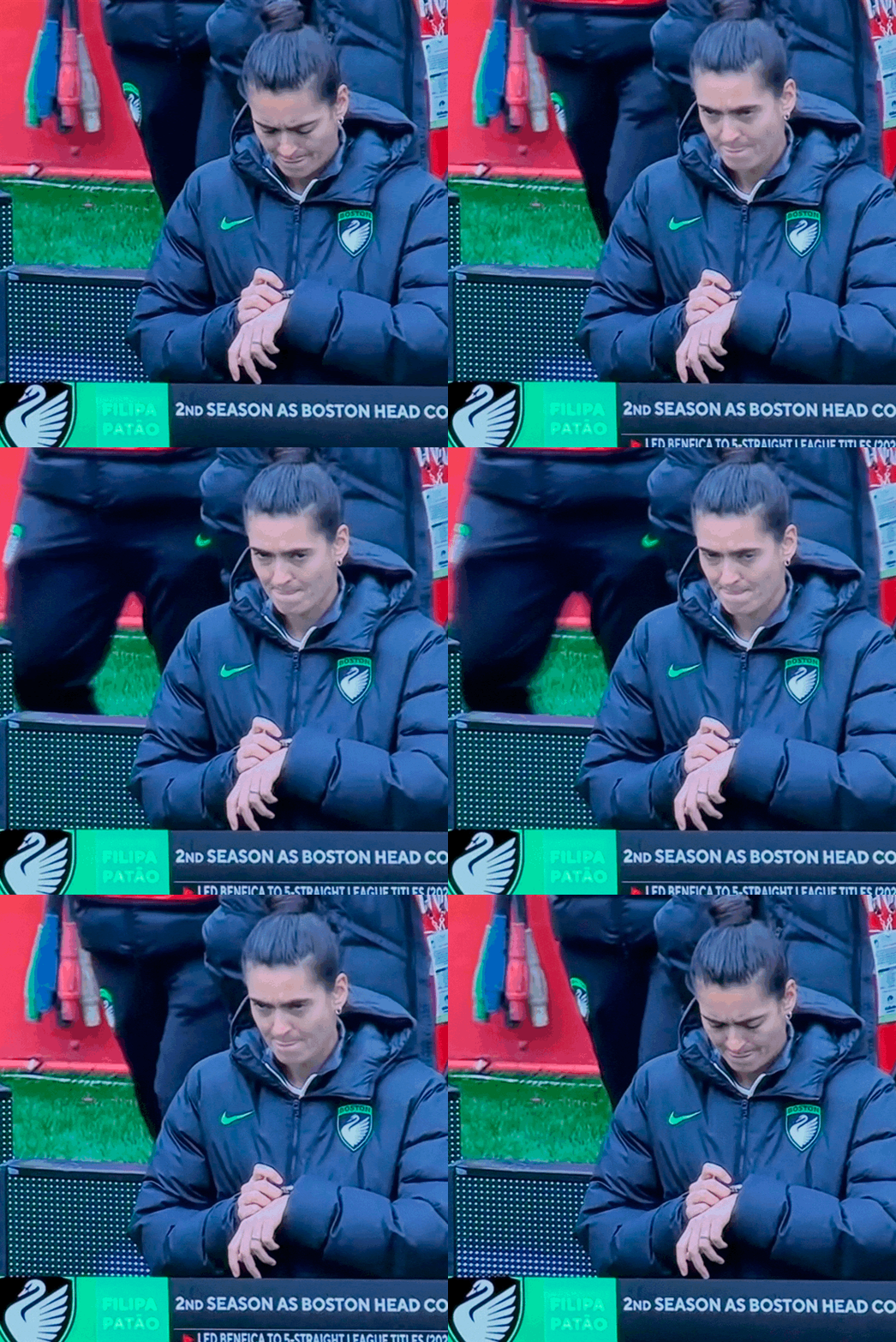
During the Boston Legacy-Denver Summit match on Sunday, May 3, from Foxborough, Massachusetts, CBS Sports showed head coach Filipa Patão on the sideline next a graphic incorrectly stating that she was in her second year coaching the team.
 Equality for women remains a one-step-forward-two-step-back affair. Time is up on the patriarchy and its tools of suppression!
The Legacy are in their first NWSL season. Filipa Patão was hired in June 2025 and began roster-building the next month. Patão is the first coach for the Boston franchise playing its inaugural season in 2026.
FURTHER READING:
[1] Facing History & Ourselves | Resource Library