

By Tamryn Spruill
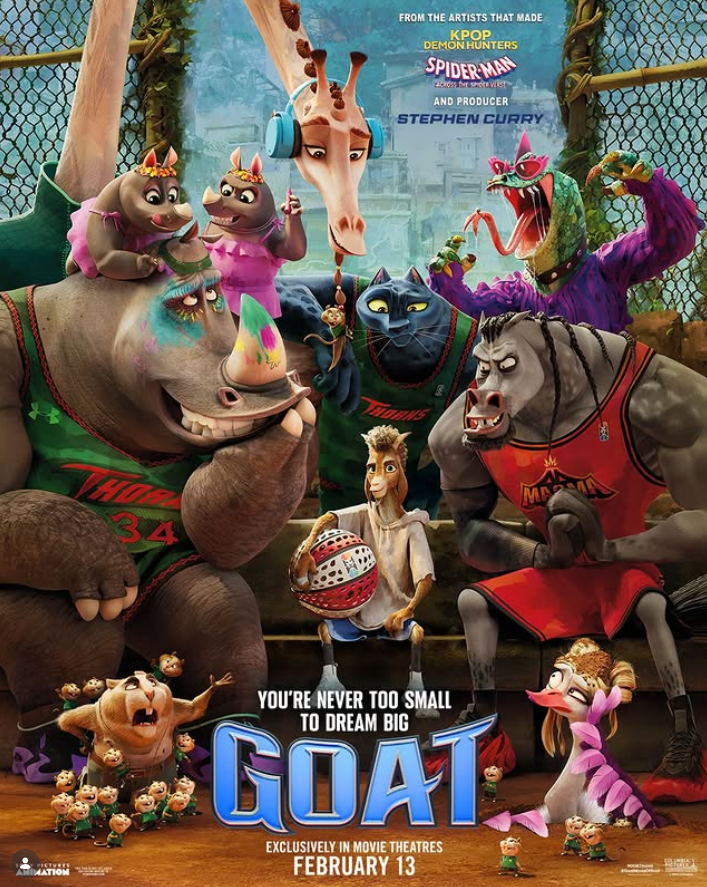
BOSTON — From producer Stephen Curry and Sony Pictures Animation, the studio behind the Spider-Verse movies, comes GOAT.
[Spoiler Alert: This review mentions plot points and thematic elements of the film.]
“This kid’s got game,” the tagline reads—the kid being Will Harris, a young goat aspiring to play basketball in the ROAR League. Voiced by Caleb McLaughlin of Stranger Things fame, Will clashes with naysayers in the fictitious Vineland for a chance to disprove the stereotype that “smalls can’t ball.” The film is based on the real-life struggles of Curry, who silenced doubters as he moved from scrawny, sharpshooting point guard to four-time NBA champion and the league’s most accomplished three-point shooter. But the similarities between Curry and Will end there.
Will’s story is his own, and the film’s heartbeat; ranging subplots add multilayered meaning. The writers deliver heavier themes with delicate, kid-friendly strokes, but with enough nuance that the adults watching with them walk away with fodder for contemplation. This approach makes comedic relief nearly unnecessary and Nick Kroll’s Modo—a Komodo dragon with a pierced, forked tongue—a source of unbridled hilarity.
At an early-access screening in Dedham, Massachusetts, on Saturday, February 7, during the beginnings of another snowfall, a diverse mix of parents and children—many boys among them, some wearing Curry jerseys or Patriots apparel—filled the 285-capacity theater. They watched as Will sought and won a roster spot with his hometown Thorns, only to have to enter into another battle for playing time. All the while, Will’s exposure to his longtime hero-turned-teammate Jett Fillmore—a 20-year veteran black leopard chasing her first Roarball title claw—opens his eyes to the dangers of hoisting mere mortals to idol status.
Hollywood stalwart Gabrielle Union anthropomorphizes Jett as a Black female basketball player. Seeing Jett on the big screen in the same week that the occupier of the highest office in the land shared a racist meme on social media depicting former President and First Lady Barack and Michelle Obama as apes—during Black History Month, no less—contextualized the current moment of chosen bleakness over the available, easily accessible alternative.
Jett is tall, muscular, dark-furred, and fashionable—the Panthera pardus incarnation of so many WNBA players. (Jett, though, laps water from a bowl on the sidelines instead of swallowing from a bottle.) She’s a beauty—revered for her speed and athleticism and admired for her enduring desire to win the Roarball championship. Will’s fascination with the superstar leopard flips toxic social narratives about the capabilities of female athletes, and women in general, on their head.
“I want to be just like her,” Will says of the aging Jett.
It’s a bold statement from the male goat.
The WNBA is enjoying heightened attention now, but as recently as 2019 Edris Elba, Leslie Jones, and Kate McKinnon appeared in an SNL skit that degraded the league and its players with homophobic and racial stereotypes. A few years before that, Blackish made the WNBA a running punchline.
- READ: Saturday Night Live steps into tired stereotypes of WNBA basketball—chorus of boos follows
- QUIZ: Are you the GOAT?
- WATCH: Gabrielle Union talks star power of Angel Reese
“God’s everywhere,” Jack tells twin Diane. “Except WNBA games—nobody goes to those.”
Out of the mouths of babes, the show-runners placed below-the-belt hits disguised as jokes. The more than 9,000 people who paid for tickets in 2015 to see the Sparks in Los Angeles, where Blackish was set, weren’t nobodies; neither were the almost 10,000 fans that attended games the following year, or the 19,076 people who gave the Sparks the WNBA’s single-game attendance record in 2016—the year the franchise won its third championship and star Candace Parker got her first.
At press junkets for GOAT, Union spoke to the impact of the WNBA, in particular the popularity of the league’s young star players, like Angel Reese of the Chicago Sky, whom the actor says stays long after games to meet and greet young fans. (Union is married to former NBA star Dwyane Wade, now partial owner the Sky.)
Reese voices a polar bear in the film, WNBA MVP A’ja Wilson hisses as a snake, and Curry—in a big departure from real life—portrays a giraffe.
Kids waiting to see Reese are “overwhelmed at the sight of her,” Union said of Reese. “Its boys and girls. There are boys who are holding their shoe—like, I got the Angel Reese shoe … and they’re looking at her in awe.”
Will is at first awestruck of Jett—until the ugly realities of professional sports reveal themselves, including the star’s personal failings, which include a struggle to be happy for her teammates’ successes and a pursuit of winning at any cost. In addition to showing the real being inside a celebrity persona, the film’s writers dug into other real-world complexities.
Aaron Buchsbaum, Teddy Riley, and Chris Tougas infused Will’s world with relatable strife: a single-parent home, the death of that parent, low-wage work, unaffordable housing, and eventual eviction, all while never giving up in his pursuit of a big dream. GOAT additionally highlights corruption in professional sports through the self-serving doings of a corrupt team owner and the toll that professional basketball takes on the human body.
The only flaw with GOAT is that the movie’s top-billed creators, from its producers and writers to directors Tyree Dillihay and Adam Rosette, reveal the degree to which Hollywood remains a boys’ club, even as some of those now-adult boys make films with opposite messaging.